


BACKGROUND
OK, this is what I’ve been working on obsessively for the past year. It is, I think, a huuuuge breakthrough. I’ve already emailed this early, rather dense version to a couple of scientists I know for feedback; but I thought I’d also slap up a copy here (lightly edited and expanded for a more general audience), for your feedback. Most importantly: Are there any obvious errors? Less importantly: Is the model clearly described? All feedback welcome, both positive and negative, on form and content. And if you want to pass this on to any friends who could provide useful feedback; great, please do. The finished, longer version will go up here when it’s done, at theeggandtherock.com
JAZZ SCIENCE
Another motivation is simply to perform this new kind of jazz science in public. Jazz science takes the classics (the enormous body of existing mainstream academic science, including its vast silos of data), and then brings some other, non-classical virtues to the stage (the often highly-developed pattern-recognition skills of the novelist, for example), in order to improvise something fresh around them. Ideally this creates something new – perhaps a medley of several old hits, played on new instruments, like evolutionary cosmology – that is valuable in its own right, but built on a solid scientific foundation. And I think the journey to that finished medley is, itself, of interest. Jazz science should be open science! And if this new approach is producing better results than the old approach – which I believe is the case here – then exactly how it’s done is may be of general value and interest to the entire scientific community. So, publish the behind-the-scenes emails (like I did with these ones), not just finished, polished posts.
ON THE RECORD
My THIRD motivation is to get this model on the record before the next wave of James Webb Space Telescope data hits the beach. A bunch of papers have recently come out that are highly supportive of the model (this one, and this one, and this one), so now I’m kicking myself for not publishing a crude, early version months ago. Don’t want to be kicking myself even harder later in the year.
LET THE RIGHTEOUS CITE ME; IT SHALL BE A KINDNESS
Not coincidentally, I am finally getting my shit together as a Proper Citable Researcher. More formally: An archived PDF version of this post has been zapped electronically to Zenodo (the general-purpose open repository operated by CERN), buried deeeeeep under a mountain in Switzerland, and assigned the following longterm, stable, digital object identifier, or DOI: 10.5281/zenodo.20437300
For priority and reference purposes, that’s the guy to cite.
And I finally got around to getting an ORCID (Open Researcher and Contributor ID), so I can no longer be confused with the other splendid Julian Goughs who bestride this narrow earth like colossi; chiefly the highly regarded and widely cited molecular biologist Julian Gough. (This is me. This is him.)
My ORCID iD: 0009-0001-0632-452X
And that DOI again (you can tell I am excited by these new toys): 10.5281/zenodo.20437300
OK, let’s go!
INTRO
Hi [scientist friend, name redacted],
So here is a short(ish) outline of the new model of spiral galaxy formation I have been working on for the past few months, in case you’d like to give feedback before I post it, or would like to pass it on to anyone else to critique. (EDIT: It was meant to be short, but ended up over 9,000 oh my God 11,000 wait, what?! 14,000 words long, because there’s so much to cover, and I kept adding fresh ideas, over many more drafts, as I had them.)
First, a warning, to help you calibrate your expectations correctly: It’s not (yet) a high-resolution, finished, precision theory! Right now, it’s deliberately and necessarily (given the limited state of our knowledge of the extremely early universe) a low-resolution, systems-level hypothesis that needs a lot of work. But I think it elegantly joins a lot of previously puzzling, scattered dots. Better, it actually links them into a causal chain; a full-stack, organic and logical, galactic developmental process. In doing so, it potentially makes sense of a remarkable number of new and startling things that the James Webb Space Telescope has seen so far in the early universe, while also explaining many of our old, longstanding observational problems. So, go me! (If I’m right.)
WHAT WE NEED TO EXPLAIN
OK, here’s the structure of a typical mature spiral galaxy, for reference. (Scribbled with my son [name redacted]’s pens, simplified and not to scale!) These are the things we need to explain.
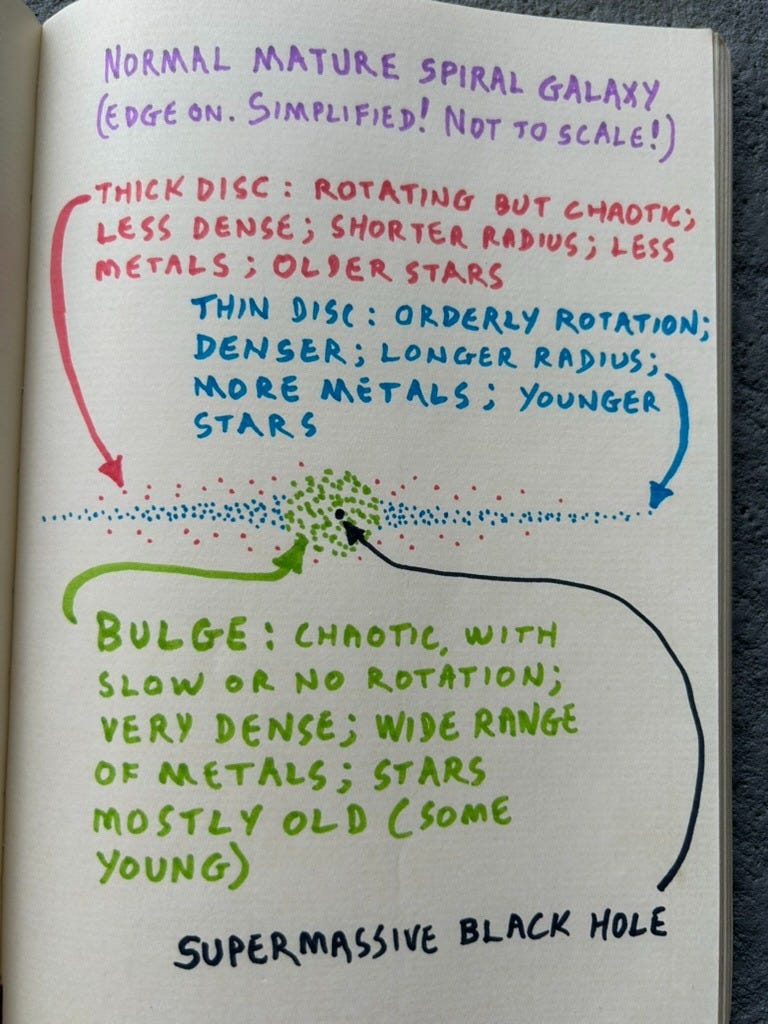
Background, so you can see what’s new about this model... (You’ll know a lot of this already, but I think it helps to lay it out.)
Spiral galaxies are known to have several common structural elements which are difficult for pure Lambda Cold Dark Matter (ΛCDM), gravity-driven, hierarchical merger-assembly models to generate. (With ΛCDM’s merger-assembly model, things just mostly bump and clump, so it can be hard to explain where complex structures come from, particularly when they appear to have emerged early and fast.) Dark matter’s gravity does OK explaining the flat rotation curve (where the stars in the disc rotate at roughly the same speed, regardless of their distance from the galactic centre). But, unassisted, it keeps bumping into the ongoing cusp/core problem, where you need to define the parameters of the dark matter – and how it therefore interacts with ordinary, visible, baryonic matter – differently for large and small galaxies to make it work. So it still has great difficulty explaining large galaxies and small galaxies at the same time.
The dark-matter-dominated, gravity-driven, hierarchical merger model has even more trouble explaining the spiral magnetic field; it can assemble the gas and plasma for the galaxy through multiple mergers, but then mostly hands over the responsibility for structure formation to semi-random gas movement. That can rather clumsily generate a spiral field from scratch, but it takes a looooong time; traditional simulations say about a billion years after the start of galaxy formation, which itself takes quite a while. Which is a problem: the James Webb Space Telescope is now seeing spirals so early, there isn’t enough time for this; for example, Zhúlóng/Torch Dragon, a grand-design spiral galaxy discovered in 2024, at redshift 5.2 (12.8 billion years ago; so, just 1 billion years after the Big Bang). From its Wikipedia entry:
“The discovery was surprising to astronomers, who had previously believed that spiral galaxies took billions of years to develop”.
(Yes, they are now retrofitting the simulations, and the theory, to belatedly match what we’re seeing; but they failed to predict it.)
Gravitationally-driven, hierarchical multiple-merger models, unassisted, have even more trouble explaining why spiral galaxies all seem to have both an orderly thin disc and a less orderly thick disc (containing far less matter), with the dense orderly thin disc embedded in the fluffier, more chaotic, thick disc. They can’t coherently and convincingly explain why the two discs have different radii (the thick disc’s is usually shorter), different stellar ages (the thick disc stars are always older) and different metallicities. (The thin disc has higher metallicities – a higher content of elements that aren’t simply hydrogen or helium – though those high levels drop off at the edge, whenever it sticks out beyond the thick disc.) The current “explanations” are a bunch of disconnected post-hoc fudges that can explain each element separately, but with no unifying coherent theory. This is a long-standing problem. As an excellent paper from last year dryly puts it,
“The formation mechanisms of the two discs and the timing of their onset remain open questions.”
(From “The emergence of galactic thin and thick discs across cosmic history”, by Takafumi Tsukui et al, June 2025, Monthly Notices of the Royal Astronomical Society.) And you can see why: it’s just very hard to get this detailed structure from a bunch of random hierarchical mergers and subsequent random gas movement (from incoming filament flows, supernova explosions, etc).
And in general, the old gravity-driven, hierarchical-merger model can’t explain why the galaxies the James Webb Space Telescope is now revealing in the early universe are consistently bigger, brighter, earlier, and more organised than predicted.
WHAT THE NEW MODEL EXPLAINS
Anyway, this model I’ve developed, if correct, gives you pretty much all of this. A strong spiral magnetic field; a bulge-and-disc structure, with thin and thick discs of the right age, size, and chemistry; early bar formation; and structureless elliptical galaxies (of the correct mass!) as its high-mass failure mode. And, for spiral galaxies, this model injects a LOT of energy into the outer thin disc, significantly flattening the overall rotation curve. It’s been a remarkable experience working through the logic of this model, as observed structural features keep smoothly and logically falling into place. A good sign!
PLAYS WELL WITH OTHERS
Also, this new model isn’t even necessarily in conflict with ΛCDM itself; just with all the gravity-driven, hierarchical, multiple-merger galaxy-assembly assumptions that have historically come with that model. The new model solves most of the existing big galactic structure formation problems without needing dark matter, but doesn’t say it doesn’t exist. In fact, the two models end up cooperating surprisingly well. For example, the new model sets up an initial flattish rotation curve, but that curve is not longterm-stable without some kind of ongoing support, so it currently hands over the maintenance problem to dark matter. So there’s still a strong potential role for ΛCDM there (along with its other current roles; explaining the cosmic microwave background power spectrum, galactic lensing etc). I feel that’s good, because the new model isn’t picking a fight with the mainstream, it’s simply solving a subset of their most pressing problems; they can just bolt this model onto their existing framework for now, and we can have genteel arguments about the full extent and influence of dark matter later, if necessary. Maybe this dynamic jets-and-fields model will ultimately expand to explain maintenance of the flattish rotation curve, and even other ΛCDM phenomena, and maybe it won’t: the equilibrium position might turn out to be that this model simply explains initial structure formation, and ΛCDM maintains it, and we all live in peace and harmony.
I would love your opinion at some point, when you’ve had time to read and digest. This is a highly compressed non-mathematical summary, with simple toy examples at the end, simply to give you the gist, and show you how all the moving parts fit together; if you like, I can send you the full 16,000 word draft (EDIT: now more like 18,000, and it will clearly blow through 20) that I’m working on, once it’s done, with all the maths and a lot more detail, but that would be a lot to dump on you in one go! See if you like this first…
BLOWTORCH THEORY II: THE COMPRESSED SPRING MODEL OF SPIRAL GALAXY FORMATION (SHORT VERSION)
ABSTRACT
It’s basically a new, comprehensive, coherent theory of spiral galaxy formation. It shows how such galaxies can be generated by the plasma jets from extremely early direct-collapse supermassive black holes. As the head of the jet is drastically slowed by the far denser, cooler plasma that surrounds the black hole, the jet blows up a hot, overpressured cocoon (hot plasma bubble). Crucially, the jet’s helical fieldlines peel off into the cocoon along with the plasma. After the jet finally breaks free of the cocoon, the cocoon rapidly cools and collapses, to form a disc. That collapse compresses the strong 3D helical fieldlines of the cocoon into an even stronger 2D spiral field (more accurately, compressed helical field) in the disc. That field, at hundreds of microgauss or even milligauss levels, is strong enough to quickly lock the plasma of the disc into solid body rotation, redistributing angular momentum through magnetic torque, and delaying star formation through magnetic support. The resulting dynamics explain thick and thin disc formation; the differing stellar ages, metallicities, radii, and stellar kinematics of the thick and thin disc; the different stellar kinetics of bulge and disc; an initial surprisingly flat rotation curve; the peculiar structure, and spectra, of Little Red Dots; etc. This all happens in a single, active, dynamic process that starts less than a hundred million years after the Big Bang, but plays out coherently over the next billion or more years.
STARTING POINT: A BUNCH OF DIRECT COLLAPSE SUPERMASSIVE BLACK HOLES
OK. This model comes straight out of Blowtorch Theory, so we’re starting with a huge wave of direct-collapse supermassive black holes, from the smooth gas of the extremely early universe, somewhere between redshifts 35 and 25. (Between just 80 and 130 million years after the Big Bang.) No stars yet, no galaxies yet. As you might remember, this is not part of the mainstream models (which assume direct collapse supermassive black holes, if they exist at all, are rarer, and later, and need stars, and stellar UV, in order to form). It’s the prediction I made back in 2022, before the James Webb Space Telescope had sent back any data, and which seems to successfully map onto the extremely early supermassive black-hole-dominated galaxies we have since seen. See:

THEY FIRE UP A DYNAMO, WHICH FIRES UP A JET
The direct collapse supermassive black holes are surrounded by blankets of extremely dense gas (mostly hydrogen) after their collapse. Close to the black hole, that hydrogen forms a rapidly rotating accretion disc of hot, charged plasma. Essentially a giant dynamo, it starts accelerating jets of plasma from its magnetic poles. Meanwhile, copious X-rays and ultraviolet light from the accretion disc quickly start to ionize all the nearby gas, turning it to plasma too.
The high initial density of that gas/plasma blanket is vital to this model, so first I need to explain how and why it’s so dense.
WHY IS THE PLASMA SO DENSE?
Remember, the mean baryon density, at redshift 30, was over 29,000 times denser than today. And the direct collapse increases that density by many orders of magnitude. Here, I’m building on direct-collapse simulation work done by Smith et al: “Radiative effects during the assembly of direct collapse black holes”, 2017. My model, extrapolating from their work, shows a scaling relationship between the mass of the black hole and that density increase, but in every case it’s many millions of times the already high density of that high-redshift era. That raises the plasma density near the newly-formed supermassive black hole to very roughly a hundred thousand hydrogen nuclei per cubic centimeter; which is approximately the density we find in the densest star-forming regions of galaxies today.1
So these early jets fire hot plasma into the extremely dense blanket of cooler plasma that surrounds such supermassive black holes after their direct collapse. (If you’re wondering why the blanket is plasma, not gas, see footnote:2 )
JETS STALL TO A CRAWL IN PLASMA THAT DENSE
The base of the jet, therefore, is accelerating hot plasma close to the speed of light; but the HEAD of the jet can’t push all that surrounding dense, cooler plasma out of its way at anything like that speed. So the jet head will flatten, broaden, and move forward at a crawl through the surrounding plasma. (By “crawl”, I mean just a few hundred kilometres per second; far less than 1% of light speed. Again, I’m drawing on well-regarded published work, and extrapolating: Bromberg et al, “The propagation of relativistic jets in external media”. Again, I find a scaling relationship – speed varies with black hole mass and therefore jet power/plasma density – but generally the initial jet head speed is much less than a thousand kilometres a second.)
STALLED JETS BLOW UP HOT BUBBLES
So where does the constantly incoming fast plasma of the jet go, when it reaches the much slower head? It has to backflow – flow sideways and back – and thereby blow up overpressured plasma cocoons. We know the physics of this, too, quite well; it’s been theorised since Blandford and Rees, and also Scheuer, in the mid-1970s. ( For example, Blandford & Rees, 1974, “A ‘twin-exhaust’ for double radio sources”.) And since then we’ve confirmed it, with a lot of observational evidence of stalled jets blowing up cocoons in thick plasma in nearby galaxies like IC 5063, and the even more romantically named 4C 31.04. (See, for example, “Jets blowing bubbles in the young radio galaxy 4c 31.04”, by H. R. M. Zovaro et al, 2019.)
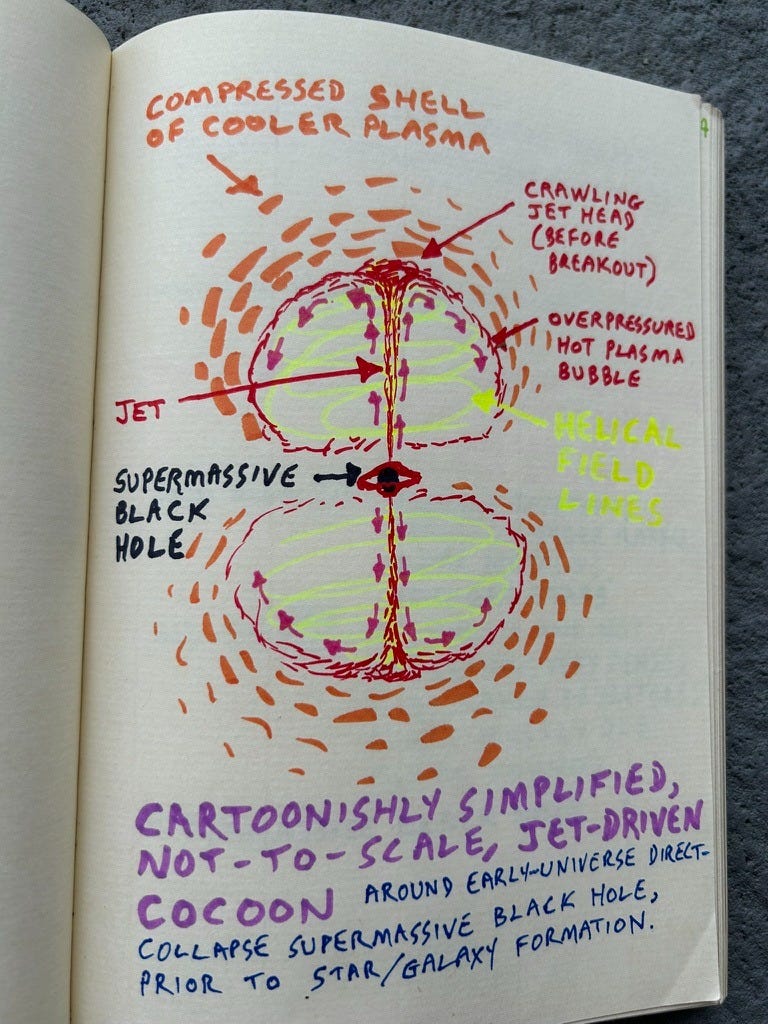
Here’s a ridiculously simplified, cartoonish, not-to-scale drawing of such a jet-driven cocoon around an early-universe, direct-collapse black hole, just so you can see what and where all the parts are.
STRUCTURE OF THE COCOON
The cocoon structure is: an expanding, mushroom-shaped hot bubble of over-pressurised plasma (back-flowing from the crawling jet head), which compresses an ever-denser layer, or shell, of cooler plasma and gas ahead of it as it expands.3 The expanding hot bubble and compressed cooler shell are separated by an electromagnetic boundary layer.
Contemporary-universe cocoons are much messier than in the diagram, as the jet is firing into an existing, very messy, galaxy; but I’m arguing these early universe cocoons should be relatively cleanly structured, because they are forming after a relatively symmetrical collapse in a relatively smooth gas and plasma environment, before stars, supernovae, etc mess it all up. (And also, of course, if Blowtorch Theory’s parent theory of three-stage cosmological natural selection is correct, the basic parameters of matter will have been fine-tuned by evolution to make this work pretty smoothly. That is, if this turns out to be what those helical jet fields, etc, are FOR – in evolutionary terms – we may be startled to see how cleanly this works.)
SCALING RELATIONSHIPS ELEGANTLY AND AUTOMATICALLY COMPRESS COCOON SIZES INTO THE REQUIRED RANGE
Those scaling relationships I’ve mentioned were a key breakthrough for the model: although the mass range of the direct collapse supermassive black holes covers many orders of magnitude, the size range of the cocoons they inflate, when I worked it out, turns out to be far less. There’s a simple, elegant, fairly obvious reason for this: the more massive the black hole, the more extensive the territory that must directly collapse to form it (collapsing a larger amount of gas/plasma to form the hole itself and a dense region around it). But this leads to an automatic rise in both the density and the radial extent of the surrounding collapsed plasma blanket, as black hole masses rise.
And this of course combines beautifully with the fact that, if larger supermassive black holes form first, and thus earlier, and thus at higher redshifts, they will be forming in already-considerably-higher-density gas/plasma. (Younger universe = smaller universe = denser universe.) That combo magnifies the compression effect.
That’s because the speed of the head of the jet automatically goes UP with jet size/power, but is automatically slowed back DOWN by increased thickness of the plasma blanket. They almost-but-not-quite cancel. So a larger black hole with a more powerful jet will be firing into a denser and more extensive blanket of plasma, which will lead to a broadened head moving at a slow crawl, almost (but not quite) regardless of black hole size and jet power. My very rough calculations say that the scaling relationship is something like: the plasma blanket density near the supermassive black hole, after direct collapse, is proportional to the black hole mass to the 7/9th power. (And then higher redshifts amplify the density even further for the more massive black holes, by amplifying the initial density of the pre-collapse gas.)
(If you’re an understandably cautious scientist who has questions about that figure; cool, you probably should! Where the hell did THAT come from! Here’s a footnote covering it: 4 )
But if that scaling relationship is correct, that would mean an increase in black hole mass of three orders of magnitude would less than double the initial head speed, and would slightly less than double the distance till breakout and thus, ultimately, the cocoon radius. (See the table at the end.) So cocoons do get bigger in radius with black hole size, but the relationship is significantly compressed, into the low kiloparsec range. (But, as the plasma comprising these only-slightly-bigger cocoons is so much denser, their mass rises much faster than their size.) OK, that’s enough on that; back to the jet that’s building the cocoon…
THE JET PUMPS THE BUBBLE FULL OF HELICAL FIELD LINES
As you may recall, jets have helical (corkscrew) magnetic fields. That’s because the jets are generated by the dynamo of the accretion disc; the hot donut of plasma spinning around the supermassive black hole at close to lightspeed. The acceleration of the charged particles of the jet away from that torus generates a magnetic field in and around the jet; that field is then twisted, by the spin of the accretion disc at the base of the jet, into a helix as it leaves. (First proposed by Blandford and Payne back in 1982, I think, in “Hydromagnetic flows from accretion disks and the production of radio jets”. Since confirmed by observation, eg Asada, K. et al. (2002), “A Helical Magnetic Field in the Jet of 3C 273”. ) OK, that we know! The following cause/effect structure-formation sequence, though, is original to my model.
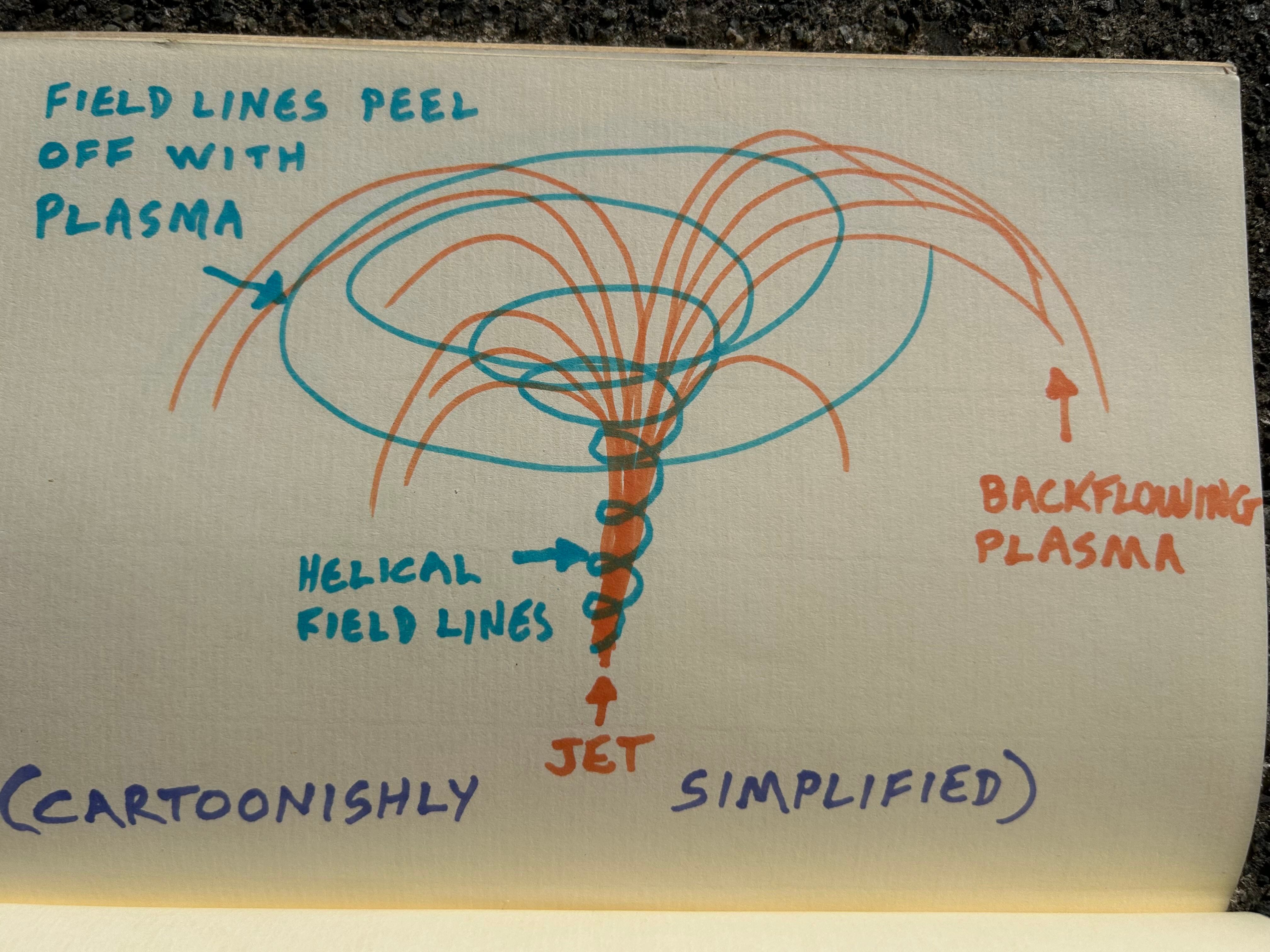
Crucially, I’m arguing that the jet’s 3D helical magnetic field peels off into the expanding bubble along with the hot plasma, imprinting a strong helical magnetic field on the cocoon. (And helical fields are strongly conserved; even strong turbulence finds it remarkably hard to erase that helicity. Plasma largely maintains “handedness”. Good paper on this: “On the resilience of helical magnetic fields to turbulent diffusion and the astrophysical implications”, Blackman and Subramanian, 2013.) So the jet’s backflow is filling the bubble with sturdy, durable, helical field lines. Hold that thought, it’s important.
BUBBLE DONE, JET MOVES ON
OK, the jet head very slowly speeds up (as it moves outward into less dense plasma, towards the thin neutral gas of the normal medium, and meets less resistance); but for several million years it is crawling slowly enough that most of the jet’s plasma backflows and blows up the bubble. However, eventually, when the jet length is in the 1 to 3 kiloparsec range (it varies with the size of the supermassive black hole, the power of the jet, and the density and extent of the surrounding plasma), the jet finally escapes the extremely thick plasma regime immediately surrounding the direct collapse supermassive black hole. The rate of acceleration begins to increase significantly, as it pushes on thinner and thinner plasma/gas; the jet head’s acceleration ramps up, until it breaks through the compressed plasma shell of the cocoon it’s been blowing up, and escapes into the far thinner plasma and neutral gas beyond. The jet is still firing, but the head is now free of the initial large overpressured cocoon, and moving at something much closer to the input speed at the base. So from now on, fresh jet plasma just shoots straight through the cocoon, and out the top through the punctured pole of the shell, and away after the accelerating head. (Where it may well carry out further structure formation, as described in the original Blowtorch Theory post.) Backflow into the cocoon stops. It can therefore no longer expand.
3D HELICAL BUBBLE COOLS AND COLLAPSES TO 2D SPIRAL DISC…
With no fresh energy input, the hot bubble of the cocoon now rapidly cools, thanks to the extremely efficient inverse-Compton cooling in that era, due to the huge number and density of Cosmic Microwave Background photons. (Inverse-Compton cooling is very roughly a million times more efficient at redshift 30 than now, as it rises approximately with redshift to the 4th power.) The whole cocoon – bubble, boundary, and compressed plasma shell – thus quickly collapses under its own gravity, to form a dense plasma disc. (Yes, a classic Zeldovich pancake!) (In fact as there are jets north and south, both lobes/cocoons semi-simultaneously collapse, but that’s too much detail for here, it’ll be in the 16,000 18,000 24,000 word version.) As it collapses, the cocoon’s 3D helical magnetic field is compressed into a much stronger, denser, 2D spiral magnetic field in that disc (like a flattened spring). Nice, huh?
…BUT NOT ALL THE WAY YET
ASIDE: Again, it’s slightly more complicated than this. (See long version!) Compressing the 3D magnetic helical field increases magnetic pressure in the plasma. (You can think of it as gravitational collapse compressing a magnetic spring.) Thus, and particularly for lower mass cocoons, around smaller supermassive black holes (in the tens or low hundreds of thousands of solar masses), as the gravitational collapse compresses the 3D helical field, and the field strength goes up, the collapse will be slowed, and ultimately halted, as the rising magnetic pressure overcomes the self-gravitation of the low-mass cocoon. So you get a puffy, magnetically-supported spheroid that can’t collapse to a disc until the strong field weakens sufficiently, which can take tens of millions, hundreds of millions or even billions of years, depending again on scale. (This, I think, explains why thin discs appear so much later in low-mass galaxies, a fact we only discovered last year: see Takafumi Tsukui’s paper again.) For these lower-mass, puffy, magnetically supported, semi-collapsed cocoons, all the things I will describe still happen, but it’s a more drawn-out process. I’ll stick with the bulkier supermassive black holes for now, in the million-plus solar mass range, where gravity is strong enough to collapse straight to something closer to a disc…
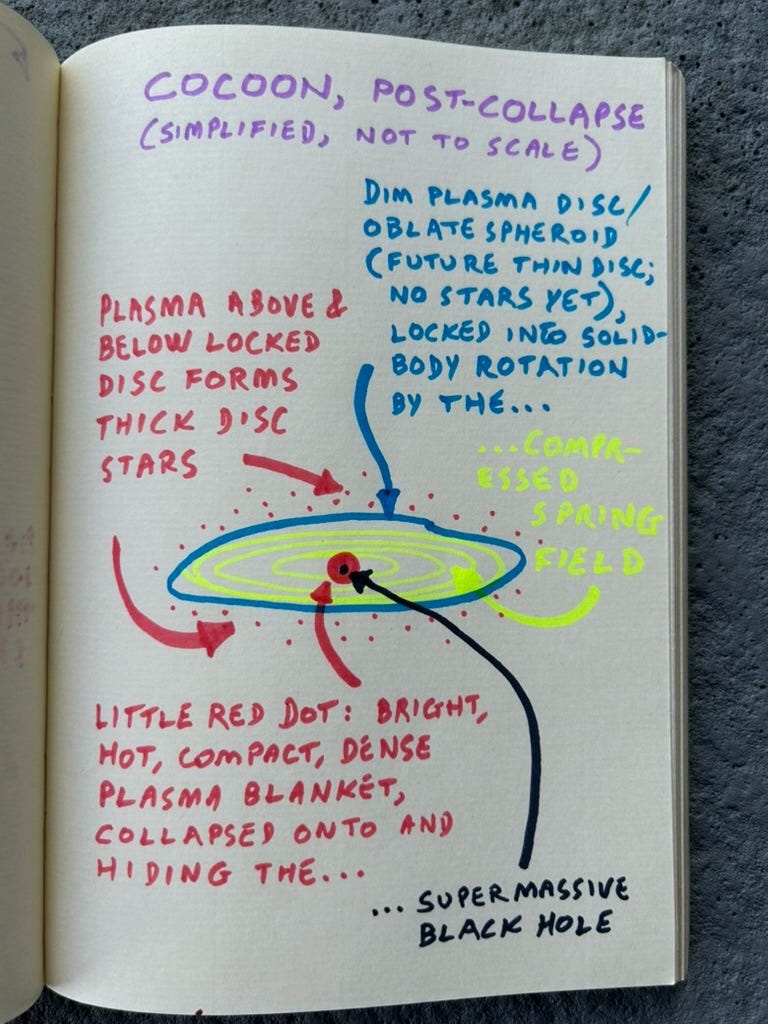
(Here’s a crude diagram of a collapsed cocoon, to give you the rough idea.)
GALACTIC SPIRAL FIELDS START AS STRONG, HIGHLY COMPRESSED HELICAL FIELDS
This process generates proto-spiral-galaxies with relatively stable and orderly discs (just plasma discs for now; no stars yet), stamped with strong spiral magnetic fields, from day one. (It’s perhaps more accurate, and useful, to think of galactic spiral fields as highly compressed helical fields, with that gravitationally compressed magnetic tension/pressure preventing both further collapse into an even thinner disc, and local collapse into stars, but again that’s for the long version…)
That’s because compressing a huge 3D volume of helical field lines into a thinner 2D disc means the spiral field can be born at hundreds of microgauss or even milligauss levels: almost three orders of magnitude stronger than the mere single-figure microgauss fields we see in contemporary spiral galaxies like our own Milky Way. (Again, like everything I’m describing, there is a compressed scaling relationship. More massive black holes generate stronger fields, but in denser plasma, leading to relatively similar outcomes across the mass range.)
THE STRONG COMPRESSED-SPRING FIELD LOCKS THE PLASMA DISC INTO SOLID BODY ROTATION
Watch the consequences play out: a milligauss field is strong enough to quickly lock most of the plasma disk into solid-body rotation, like a vinyl LP, within an orbit or two. (Yes, I’ve checked out the math. With such a high field strength, the Alfvén speed is excellent.)
In fact, this entire process bears amusing similarities to the way in which the old long-playing records were stamped out of a hot blob of vinyl, to make a disc with a spiral groove. I therefore initially thought we should call this highly dynamic, single-shot process the Hot Stamp model of spiral galaxy formation. But as I kept working on the model I realised the extent to which the compression of the 3D helical field into a springy, energy-packed spiral field was so important, so now I think maybe the Compressed Spring model would be more informative… (Not sure. Thoughts welcome.)
FIELD STRENGTH > GRAVITY, SO NO STARS YET
Note that this locked plasma disc is magnetically supported by the strong field in this solid-body phase, so it can’t collapse to form stars yet. This is even more obvious with lower-mass collapsed cocoons (around small supermassive black holes), which are so strongly magnetically supported (and so low in mass), their gravitational collapse is slowed and stopped by magnetic pressure long before they’re compressed to a disc. Borrowing a slightly inappropriate formula from the study of star-making clouds that nonetheless gets across the gist: λ ≡ 2π by the square root of G (the gravitational constant) by Σ (the surface density of the plasma), over B (the field strength). So if λ is greater than one, gravity wins, and it can collapse. If λ is less than one, the magnetic field has won, and it can’t collapse. The strong field holds them up like scaffolding, or a skeleton, (or maybe the springs in a mattress). So lighter cocoons of lower density only semi-collapse at the start, after cooling; they’re very puffy, not really a true disc yet. (Hmmm, this initial maximum-strength milligauss field really needs a name. Again, I think Compressed Spring Field gets across the hidden topology, its collapse history, and the strong, energetic, magnetic support aspect...) Anyway, all this locked plasma is destined to become the “thin disc” component of the mature spiral galaxy. (See the first illustration again, if you need a reminder.)
BUT FRINGE PLASMA IS FREE TO FORM STARS
However, though up to 90% of the collapsed plasma is quickly locked into solid body rotation (in the future thin disc), some of the collapsed plasma ends up too far, vertically, from the 2D field (or compressed spring field) to be captured and magnetically supported and heated by it. That fringe plasma is therefore free to quickly cool and form stars – many of them big, crude, and fast-burning, because pure hydrogen/helium, in the absence of other elements, finds it hard to make small, efficient, longlived stars. (And those other elements haven’t formed yet, because they only form in stars!) Those early, crude stars become the thick disc component of the galaxy.5
THE THICK DISC STARS ENRICH THE THIN DISC PLASMA
Over hundreds of millions, or even billions of years, supernova explosions in that thick disc (as its stars age and explode), rain down all the elements they formed by fusion over the course of their lifetime on the thin, dense, locked plasma disc. (Again, there’s a scaling relation. The whole process is quicker for high-mass galaxies, which is why large spirals can look mature surprisingly early.) Remember, the (still plasma, no stars!) thin disc is embedded in the (starmaking!) thick disc, while weighing up to ten times as much as it, thus dominating the local gravity well: the rain of elements therefore doesn’t distribute randomly, it disproportionately falls back down into the dense thin disc. This enriches the gas from which the thin disc’s stars will eventually form.
THE THIN DISC UNLOCKS, RELAXES, AND EXPANDS
As the thin disc’s field strength falls, over hundreds of millions of years (and the thin disc finally completes its long, slow gravitational collapse), it gradually releases the locked plasma of the thin disc, which now spreads out radially, to better balance its centrifugal force against gravity. (Angular momentum has to be preserved. But angular momentum is just velocity times radius, so now that it’s released from magnetic tension, if the rapidly rotating outer plasma wants to lower the crazy velocity it was forced into by all that magnetic torque, it has to raise its radius by drifting further out.)
…WHICH EXPLAINS MULTIPLE, OTHERWISE PUZZLING, OBSERVATIONS
This means that – even though they start off the same – the thin disc’s radius ends up larger than that of the thick disc, matching observations in our Milky Way (and most spiral galaxies). As star formation in the thin disc is considerably delayed by magnetic support, thin disc stars are born later, and are therefore younger (and are born more enriched) than thick disc stars, also matching observations. And this whole process takes longer in low-mass galaxies, where self-gravitation is underpowered relative to magnetic pressure; also matching observations. (See Tsukui et al’s 2025 thin disc / thick disc paper again for those observations.)
Oh, and another interesting implication of my model is that the gas and stars in the outer region of the thin disc – which expanded radially away from the thick disc as magnetic relaxation began – should be lower in metallicity than the inner region of the thin disc. That’s because, after it moved out from under the thick disc, the outer region no longer got as much supernova enrichment raining down on it as did the inner thin disc region which remained embedded in the thick disc. Yep, matches observations.
All this explains the thin/thick structure of discs in spiral galaxies AND the different kinematics, stellar ages, and chemical compositions of the thick and thin discs. Plus how and why the speed of thin-disc development rises with mass. It’s a really remarkable fit.
And see how elegant and robust the mechanism is? The magnetic spring is under gravitational compression; as the milligauss field fades, and the ionised fraction drops, the thin disc (not quite thin yet; often still a puffy oblate spheroid), automatically compresses further under gravity, pushing the remaining field lines closer together, which strengthens the field and returns the system to equilibrium – thus keeping the plasma (and, as time goes by, more and more gas) of the thin disc (slowly getting thinner all the time!) from fragmenting into stars too soon. Which allows it the necessary time for deep enrichment from the stars of the thick disc that surround it, raining down elements from supernova explosions, and neutron star mergers.
THE ENRICHMENT TIMELINE
A lot of the life-friendly elements (oxygen through to calcium) are generated early on by the classic Type II core-collapse supernova explosions of large, short-lived stars (and a LOT of the stars in the thick disc are large and shortlived, for the reasons given above); but many of the (harder to build; more recently evolved; heavier) technology-friendly elements can only be generated much later, by white dwarf supernovae (which give you iron, manganese, nickel) and neutron star mergers (which make and distribute the really heavy shit: strontium, yttrium, zirconium, silver, palladium, barium, lanthanum, cerium, europium, gold, platinum, lead, thorium, uranium…). But both of those take a much longer time to start happening than do the classic, big star, burn-fast-die-young, Type II supernovae. So you need hundreds of millions years (ideally, over a billion years) for full, deep enrichment. For the build-out and distribution of the full periodic table. At the end of which, the strong field at last, automatically, has weakened enough to allow cooling of much of the plasma to neutral gas; and the thin disc is finally ready to start churning out enriched stars with planets and moons capable of generating life and technology – and small black holes. (I was delighted to be informed recently, by the splendid Adam Marblestone of Convergent Research, that the physicist Jeffrey Shainline of the National Institute of Standards and Technology had predicted this evolved fine-tuning in his 2019 paper, “Does Cosmological Evolution Select for Technology?” My model provides some of the mechanism.)
THE ENRICHMENT PAUSE (STARMAKING CEASES)
It looks to me, therefore, like there should be a slow wave of thick-disc star formation between redshifts 35 and 25 (as the cocoons collapse in size order, and a fuzz of mostly crude and massive just-hydrogen and-helium stars form around them), followed by a kind of supernova-enrichment-pause, with very little new star formation for tens of millions of years (at a minimum, extending in many cases to hundreds of millions of years), as most of the plasma in the collapsed cocoon has either formed stars (the minority-of-collapsed-plasma in the thick disc) or is locked in magnetically-supported solid body rotation (the majority-of-collapsed-plasma in the thin disc). Eventually, gravity finally overcomes the weakening compressed-spring field; the magnetically tensioned plasma slowly transitions to neutral gas; and somewhere between redshifts 20 and 10, the first thin discs begin to unlock, relax, spread out and start forming stars, with that process accelerating to a peak around redshifts 2 to 3 (“Cosmic Noon”). (As I work on the model, these dates may shift!)
CAN WE SEE ALREADY SEE EVIDENCE?
With our current instruments, it’s going to be difficult, and maybe impossible, to see the first wave of thick disc star formation at redshifts 35 to 25 (too distant, too dim, too much not-yet-ionized neutral gas in the way soaking up the light), but we should already be able to see the later, second wave of star formation, around redshift 15 or so, as the thin disc unlocks.
There’s some interesting evidence for this in a new paper (posted on arXiv just last month) showing that star formation in general does indeed seem to speed up abruptly around redshift 15: “A search for the first galaxies across >0.6𝐝𝐞𝐠𝟐 of JWST imaging: new evidence for a rapid decline in star-formation activity at 𝐳>𝟏𝟐”, by D. J. McLeod, J. S. Dunlop, et al. From their abstract:
“Moreover, based on a notable lack of galaxy candidates at z>14.5, we find evidence for an even more rapid descent in star-formation activity towards earlier times, with our new measurement of ρSFR at z≃15.5 lying significantly below an extrapolation of the log-linear ρSFR(z) relation inferred from early JWST LF studies.”
Very suggestive! (Once you translate it into English.) Basically, the old passive, hierarchical, bottom-up, multiple-merger galaxy-formation model has always assumed ultraviolet-bright (heavily star-forming) galaxies should get rarer and rarer the further back you look, because there has been so much less time to passively and randomly build such a galaxy. It also assumes a fairly linear dropoff as you go back in time. But, as this paper says, the James Webb Space Telescope keeps seeing HUGE numbers of heavily starforming galaxies in the early universe, everywhere it looks, out to redshift 10-plus. Recent papers therefore all nervously say things like “The early universe has more bright UV galaxies than a classic luminosity-function shape would predict.” Yet, past redshift 15, we now see there is an abrupt dropoff! Very non-linear… All very odd, under the old model. You can make it fit, with difficulty, after the fact, but it wasn’t what was predicted.
But this makes perfect sense if this new dynamic, jet-driven, compressed-spring model of galaxy formation is correct – a single coherent top-down process, playing out step by step everywhere – and what we are seeing are all the thin discs finally unlocking in a long wave. Bright UV galaxies wouldn’t be rare that early, they would be extremely common! We should be seeing waves of bursty star formation starting to kick off everywhere, somewhere just before redshift 15 (a bit more than 250 million years after the Big Bang), with the rate then accelerating over time (and peaking visually, in our instruments, at Cosmic Noon), as more and more gas, and more and more discs, unlock.
THE IMPLICATIONS FOR LIFE AND TECHNOLOGY


And note that this beautiful, complex process, in holding back so much star formation for so long, actually accelerates the timeline for the production of life (and technology), while massively increasing the number of stars and planets and moons capable of producing both. Without the magnetic locking of up to 90% of the gas in the galaxy in the thin disc, it would all just rapidly cool and collapse and turn into lots of early, low-metallicity stars (as happens in ellipticals), with no possibility of complex life or technology, because the required elements simply wouldn’t have been made and distributed in time.
Again, this shows the enormous benefit of the three-stage cosmological selection model; of a Darwinian evolutionary model that sees life (and technology) as developmental stages that have been evolved for, that this universe is therefore fine-tuned to produce. You’re allowed to have a reason for things; which means you are able to recognise what you are looking at.
I’ve taken on spiral galaxy formation here, but almost every question in cosmology needs to be similarly reexamined through the lens of evolution…
“Nothing in cosmology makes sense except in the light of evolution. Seen in the light of evolution, cosmology is, perhaps, intellectually the most satisfying and inspiring science. Without that light it becomes a pile of sundry facts some of them interesting or curious but making no meaningful picture as a whole.”
–Me, in 2026, doing a little jazz science improvisation around evolutionary biologist Theodosius Dobzhansky’s classic(al) 1973 essay, "Nothing in biology makes sense except in the light of evolution", which is well worth reading; here it is.
WHY SPIRAL GALAXIES HAVE A CHAOTIC BULGE
But, anyway, having explained the spiral disk, we now get to explain the bulge!
Again, preservation of angular momentum meant that the move to solid body rotation required a huge transfer of angular momentum from the inner region to the outer region of the thin disc (via magnetic torque), as the spiral field lines were stretched, and resisted that stretching. Basically, the energy required to speed up the outer region was taken from the inner region, slowing it down.
In many (though not all) galaxies, so much angular momentum is lost from the inner region that, with the fading of the field and subsequent loss of magnetic support, this inner ten or twenty percent of the plasma now loses rotational stability, and becomes chaotic. (For an interesting complicating factor, see footnote four: 6 )
Stars born later from this turbulent central plasma, as it cools, should all whizz around fairly randomly – sometimes with some sloppy surviving overall rotation and sometimes not – as we indeed see in today’s classical bulges. So, let’s examine the three parts of the galaxy we should see if this compressed-spring model is correct:
1.) Central bulge: a high velocity dispersion, and slow, or no, overall rotation.
2.) Thick disc: also high velocity dispersion, but with overall disorderly rotation.
3.) But the thin disc, with its strong spiral magnetic field, remains orderly, with the rotation of its plasma (and, later, the stars born from that plasma) highly coordinated: thus, there’s a low velocity dispersion in the rotating thin disc.
In other words, exactly what we see today. It’s neat, isn’t it?
WHY THIS ALL LEADS TO BURSTY STAR FORMATION
OK, the strong magnetic field, in supporting solid-body rotation, and pushing back with magnetic pressure against gravitational collapse, prevented local collapses into stars till now. Its slow easing over time (due to slow, ongoing reconnection, ambipolar diffusion, inflows of disruptive turbulent gas from filaments, etc), allows the cooling over time of the plasma of the thin disc to form neutral gas, triggering intense waves of star formation. The mechanism looks, to me, nicely automatic: as the field begins to fade and release neutral gas, and as that gas tries to move outward to balance centrifugal force against gravity, the remaining spiral magnetic-field arms of locked plasma will physically – collisionally rather than magnetically – “snowplough” that neutral gas into spiral heaps of dense neutral gas in the spiral arms, where it will rapidly form stars in huge bursts. (With all this starting to really kick off very roughly around redshift 15!) So early stellar nurseries are built dynamically.7
If the inner radii unlock first (as my model indicates is likely), then early, high redshift-galaxies will appear to us to be even more compact than they are, as star formation slowly works its way outward from the center, while the outer plasma, still locked and thus without stars yet, remains invisible to us.
And “cosmic noon” – the era in which we observe the most intense star formation, very roughly between redshifts 2 and 3 (when the universe was, coincidentally, 2 to 3 billion years old) – may simply be the period in which most of those locked, enriched, plasma discs finally unlock the majority of their plasma as gas, allowing it to relax, spread out, and form stars.
WHY SPIRAL GALAXIES ARE BORN WITH SURPRISINGLY FLAT ROTATION CURVES
But the stars formed from that former plasma of course inherit its motion: and look what happened to that plasma’s motion, first during the period where it was locked into solid body rotation by the initial, strong, Compressed Spring Field, and then when that field relaxed…
Remember, the magnetic locking period transferred a HUGE amount of energy to the outer plasma, with magnetic torque (transmitted along the spiral magnetic field lines) speeding up the outer plasma and slowing down the inner plasma till they all rotate at the same angular speed. (Solid body rotation!) That’s basically a redistribution of angular momentum that is stable for as long as the field strength is strong enough to hold it all together (like a coiled spring). But when the field fades and the plasma is released from that magnetic support/tension, the inner plasma finds it is now travelling too slowly to support itself at that radius, and so it collapses inward to form the chaotic bulge. But the outer plasma is traveling too fast to support itself at that radius, and must drift outward. (Increase the radius, and thus decrease its velocity.)
Outer stars are therefore born rotating surprisingly fast, and inner stars surprisingly slowly, compared to a naive merger-driven disc model (where angular momentum wasn’t redistributed outward by magnetic torque during a solid-body-rotation phase). This tends to very roughly equalise their speeds. Thus (and to my own great surprise), this model starts those spiral galaxies off with remarkably flattened rotation curves, where the stars in the disk all orbit at relatively similar speeds, despite their different distances from the galactic center.
I’m perfectly happy to leave the maintenance of that flat(ish) rotation curve to cold dark matter for now; but isn’t it intriguing to see a baryon-only mechanism that can potentially start off a spiral galaxy with something that looks suspiciously like a flat rotation curve?
WHY THE THIN DISC IS BORN KINEMATICALLY COLD
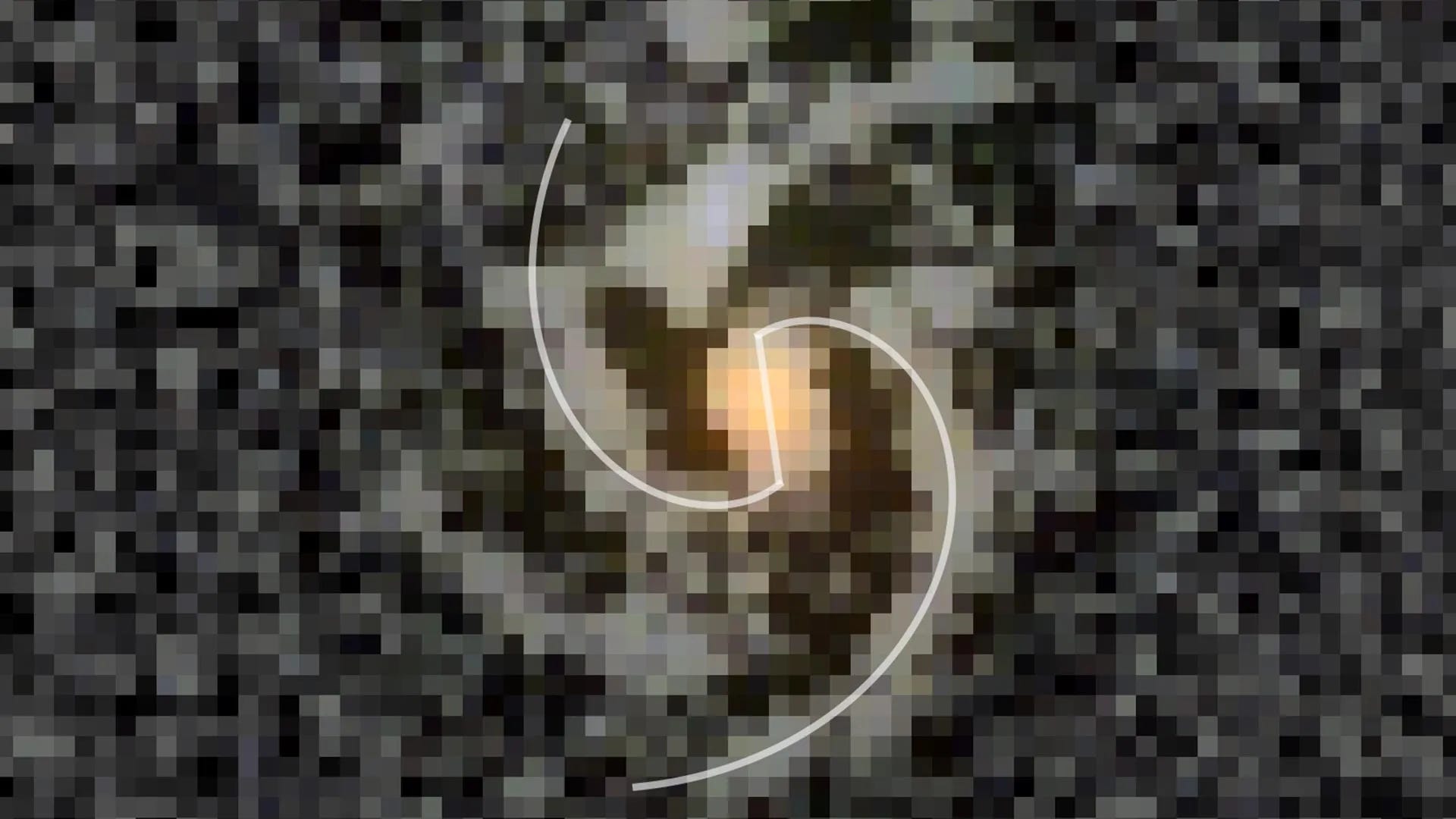
There is one more elegant twist: the lock into solid body rotation has left the thin disc kinematically cold from the very start. That’s not heat/temperature cold. “Kinematically cold” means there’s remarkably little random motion (as the strong field overwhelmed and suppressed a great deal of thermal and other random motion, while redistributing angular momentum, and thus energy, and thereby ordering the thin disc); and so stars are born, as we’ve seen, with orderly motion, moving in similar orbits at similar speeds. That means that the disc can potentially form a bar remarkably early, as soon as a majority of its gas has turned into stars. (Bars form in kinematically cold disks, but gas, acting as a kind of sloshy shock absorber, tends to suppress bar formation.) This explains the extremely early, star-rich, gas-poor, spirals-with-startlingly-mature bars that the James Webb is now seeing inside the first couple of billion years, long before such galaxies were expected to form; though of course they are now retrofitting the models that failed to predict this. (See this recent news of a barred spiral just 2 billion years after the Big Bang…)
LARGE CHAOTIC ELLIPTICAL GALAXIES ARE THE HIGH-MASS FAILURE MODE
So this new model explains spiral galaxy formation in startling detail. But what about the larger, more unstructured and chaotic elliptical galaxies? Well, it looks to me as though ellipticals are this model’s high-mass failure mode; the jet/bubble/cocoon part all goes according to plan, but above very roughly 10 to the 10 solar masses, you will tend to end up with multiple problems. At this far end of the scaling relation, field strengths finally do become too high during the collapse, and collapsing cocoons can be blown apart by excessive magnetic pressure. And when cocoons this massive do manage to collapse without breaking, they form plasma discs that can be too large, and too dense, to redistribute their angular momentum rapidly enough to lock solid. (The Alfvén speed is too slow in the much denser plasma.)
Looking at the problem from another angle: disc radius grows remarkably slowly with mass, but it does grow. And extremely massive discs therefore begin to have a radius so large that the plasma at the outer fringe of the disc would have to be accelerated to an impossibly high speed in order to achieve solid body rotation. Even a multi-milligauss field can’t exert enough torque to do so. (Basically, fields large enough to do it would blow up the disc.) So it’s a double, maybe triple problem at that size: the Alfvén speed isn’t high enough to lock them in time, and the field strength either isn’t high enough to achieve the required crazy-high torque at the outer fringe, or is so high it blows up the disc. There is no longer a sweet spot, as the scaling relation hits its upper limit. The spiral (or compressed helical) field, unable to lock the disc solid inside a rotation or two, gets stretched and tangled and breaks up through turbulence and reconnection events. Such large discs therefore can’t attain long-term stable structure. Instead, such a disc rapidly forms a massive, chaotic, short-lived, elliptical galaxy, as the entire vast disc disintegrates, kicking off explosive star-formation as multiple unsupported local areas collapse. (The disintegration of such a massive failed disc would look suspiciously like the situation described in this recent paper in Nature Astronomy, “Extended enriched gas in a multi-galaxy merger at redshift 6.7” by Hu, Papovic et al. Is this really five galaxies and more than 17 “galaxy-size clumps”, all mysteriously merging in a tiny region, or is it mostly one huge disc, at the upper limit of viability, belatedly disintegrating? My guess is the latter. An “extended region of enriched gas”, studded with small-galaxy-sized bursty starforming regions, is exactly what a failing oversized locked disc would look like.)
In a delightful fit with observational data, the cocoon mass at which successful collapse into a plasma disc, followed by magnetic lock into solid body rotation, becomes increasingly difficult seems to be somewhere between 10 to the 9, and 5x10 to the 10 solar masses. Which overlaps with the classic transition mass between spirals and ellipticals; a pretty clear threshold, though with a small amount of scatter.8
So this model elegantly explains both spiral AND elliptical galaxy formation, and maps cleanly onto their observed masses in the relevant eras.
SMALL CHAOTIC IRREGULAR GALAXIES ARE THE LOW-MASS FAILURE MODE
Irregular galaxies are presumably the low-mass failure mode: smaller galaxies, generated by a smaller direct collapse supermassive black hole, where the jet wasn’t powerful enough to build a cocoon massive enough to collapse under its own gravity, or with a sufficiently strong 3D magnetic field to stabilise the later 2D disc. You just end up with a puffy mess.9
MORE STUFF THIS MODEL EXPLAINS…
It explains why extremely young galaxies appear so dense and compact (collapsed cocoons are dense and compact!); how and why they stretch out to much lower densities later; how they can have orderly spiral discs so early; and how and why their star formation is so bursty.
It explains why high rates of star formation abruptly appear only around redshift 15, why peak star formation is delayed until redshifts 2 and 3, and how and why those stars already have such high metallicities.
It explains extremely early bar formation.
And so on, and so on…
…INCLUDING LITTLE RED DOTS!
This model also potentially explains the curious characteristics of many of the tiny, point-source (or point-like-source) Little Red Dots astronomers were so startled to discover recently (2022 onwards) in the very early universe. (Here’s a good general overview of where we are now at with Little Red Dots, published in Aeon just last month.) My new model argues they are simply the bright central 1% of hot plasma at the collapsed cocoon’s core, where it has fallen back onto the supermassive black hole and been locally heated by the extreme radiation of the accretion disk. (Which generates so much turbulence and reconnection that it trashes any compressed helical fieldlines at that central point, contributing to later chaotic bulge dynamics.) And sure enough, the predicted spectrum from the Hot Stamp/Compressed Spring model closely matches the key details we are actually seeing.
WHAT WE SHOULD SEE
The Compressed Spring model would say we shouldn’t see X-rays from the accretion disc, even though it should be blazing hot in that frequency range, because the immediate blanket of collapsed plasma (light-weeks or light-months thick) should be too thick for X-rays to escape in a straight line. But, in failing to escape, they should heat that hot plasma blanket a LOT, and so you should get a lot of lovely red reprocessed light eventually emerging from it. That’s the compact, red part of the dot.
Overall, we should see a V-shaped spectrum, with that reprocessed, longer wavelength red light (mostly from the collapsed cocoon core, plus, more dimly and spread out, from some older thick disc stars) at one end, and more energetic, shorter wavelength ultraviolet/blue light (from bursty star formation in the relaxing disc, further out from the core) at the other. And a Balmer break dropoff in the middle, from where the somewhat excited gas/plasma, in the rather harsh radiation regime just outside the core, has made the gas opaque to a bunch of specific wavelengths. The red light should be very centrally concentrated (a semi-point source) and the blue/ultraviolet slightly more spread out.
WHAT WE DO SEE
And that’s what we are seeing! We don’t have many high-quality observations yet, but all of those features have already been spotted in a significant number of the best-observed Little Red Dots. (True, we can’t resolve enough detail yet in most dots to see if the ultraviolet light is more spread out; but in most of the ones we can resolve, it is.)
And note that I wasn’t chasing Little Red Dots when I started this, back in July: I was just exploring the logical consequences of my model of extremely early direct collapse supermassive black hole formation, and Little Red Dots fell out the other end. Very encouraging!
NOW LET’S DO IT ALL AGAIN, BACKWARDS, IN HEELS, WITH MATHS

[Note to general readers: If you hate and fear maths, no problem, skip ahead to the Predictions section. But I’ve tried to keep the math simple, clear and interesting; maybe give it a try first.]
So the narrative version is extremely elegant and satisfying; but of course it also needs to work mathematically, or it’s just a nice story. Trouble is, modelling it is horrendously difficult, because it requires detailed modelling of, not just direct collapse supermassive black holes and the consequent nearby plasma flow (which is hard enough), but of the magnetic field lines in that plasma, and their orientation and effects, in jets, cocoons, discs, etc, at multiple scales, over many hundreds of millions of years, while fully incorporating gravity and the physical interactions of matter – some of which is moving at relativistic speeds. You can see why nobody taking a bottom-up, maths-first approach has come up with this model. The maths gets obscenely complicated, and if you want to simulate the whole process, the compute required is off the scale. (No existing simulator could model this at the right level of detail to check it; you’d need to break it up into multiple parts at different scales, and model each step separately.) And remember, standard ideal magnetohydrodynamics simplifies its treatment of magnetic fields to the point where it can’t really model this in full. (It tends to treat plasma as quasi-neutral, only modelling some electromagnetic effects, while assuming others cancel out locally, and so can be ignored.) There are richer versions of magnetohydrodynamics that incorporate fields and their effects more thoroughly, and thus realistically, but because they require so much more granular detail to compute, they can’t be used for large-scale modelling. So, the tools just don’t exist yet. And the existing literature is, understandably and unavoidably, compromised by these limitations. Bromberg’s slow-jet-head formula, for example, which seems to be the best one out there, and which I’ve used a lot here, is for a simplified, unmagnetised jet. But in my model, the helical field of the jet, and how it peels off, and what that does to the cocoon width, and to the jet head area, and the jet itself, is clearly extremely important. Likewise, Smith’s formula for working out the density of the plasma blanket around a direct collapse supermassive black hole is great – I’ve leaned on it heavily – but it’s a simplification that only covers a single mass of black hole, at a single redshift that’s outside the range explored in my model. This whole area is under-theorised – it’s a new model! Nobody has simulated it in full yet! It doesn’t seem to have occurred to anyone else that supermassive black holes have to form first, before star and galaxy formation, and that this will then naturally have these consequences! So all the current figures in the model will almost certainly have to be adjusted as we do more accurate calculations, and run our own more accurate simulations.
Nonetheless, I think I can show you, with some very rough, simplistic, back-of-half-an-envelope takes, that there IS a reassuringly large mathematical possibility space for this model to be true, that doesn’t require any wild assumptions.10 If you see any errors I missed, point them out. (And bear in mind, it’s the simplest of toy models. I’m not arguing this is comprehensive and accurate, just that it shows there is a real space there for a better, more accurate model.)
Everything falls surprisingly neatly out of that density/mass scaling relation I mentioned earlier. (Of course, the neatness isn’t surprising if the theory is true! It would just be a natural consequence of that. And a highly evolved universe should be fine-tuned for this kind of dynamic, efficient, works-at-all-scales, structure formation.)
If the density of the blanket of plasma immediately surrounding the supermassive black hole after its direct collapse is proportional to the mass of the supermassive black hole to the seven-ninths (which seems reasonable, or at least not obviously unreasonable), then the cocoon radius/black hole mass relation is highly compressed – cocoon radius doesn’t go up much with black hole mass – while the cocoon mass/black hole mass relation, though somewhat compressed, is much steeper – the cocoon’s mass rises with black hole mass much faster than does the cocoon’s radius. So, this is our key starting assumption for now (which will need to be tested in simulation, and which may have to be adjusted).
How I worked out this scaling relation is in the 16,000 word (20,000 word?) version; but basically I took a good-quality, high-resolution simulation from that excellent 2017 paper (by Aaron Smith, Volker Bromm and others), for a smaller direct collapse black hole at a less extreme redshift (10 to the five solar masses at redshift 11.6), borrowed their plasma density profile for the zone just outside the supermassive black hole (how plasma density drops off as you move away from it), and did some (OK, a lot of) cheeky extrapolating. What I need to do next is run my own simulations across a range of masses/redshifts to confirm. (That excellent paper here: “Radiative effects during the assembly of direct collapse black holes”, by Aaron Smith et al, 2017.)

Here’s their density profile, which is nailed to that specific black hole mass and redshift (at a reference point ten parsecs out from the black hole, thus the 10pc):
(I’m having a terrible time trying to type or paste formulae into this email, everything loses formatting and turns into nonsense, so I’ll just screenshot it.)

And they find that the enclosed gas mass scales as

OK, first let’s look at the delicious consequences of applying my model’s scaling relation to Smith et al’s density profile! Firstly, remember there’s a SECOND factor that will affect the plasma density around the newly formed black hole. Plasma density already increases, a lot, with the redshift, z, because as Planck tells us, mean plasma density scales as (1+z) cubed.
(ρb is baryon density, so basically plasma density, and ρb,0 is baryon density at redshift zero, so now.) In a smaller universe, everything is obviously closer together, so density at redshift 1 is (1+1) cubed = 8, at redshift 9 is (1+9) cubed = 1000, at redshift 35 is 1+35) cubed = 46,656.) So plasma density hugely increases with the collapse to form the black hole, but also increases a lot with the redshift. (Hold that thought.)

So if we adapt Smith’s (very specific mass/redshift) radial density to work across all redshifts (via Planck), and all masses of supermassive black hole (via my scaling rule), we get this charming and extremely useful formula for working out the ambient density at any nearby radius near any size supermassive black hole at any redshift:

Sure, it’s a gross simplification, and contains some assumptions that may need adjusting.11 But it captures most of the big factors pretty well, and it lets us estimate a LOT of interesting things, with fascinating results…
First, let’s estimate jet head speed across the whole mass range and redshift range. Simplifying slightly, and borrowing a formula for this slow jet head regime from Bromberg et al, we know that the speed of the jet head (the tip of the jet punching into the surrounding gas) is roughly equal to the square root of the power pushing the head forward, divided by the density of the surrounding gas, times the cross-sectional area of the head (times the speed of light).
So, as black hole masses rise across their range of initial sizes, the starting jet head-speed is driven up by the increased power of the larger jet, but driven back down by the increased density of the plasma. (So you can see already that, despite the huge range of initial supermassive black hole masses, there is going to be a surprising compression of outcomes.) And, once in movement, the speed of the head of the jet also drops as the radius of the head gets wider, but speeds up as the plasma thins out, further out.
Then let’s just assume a few not-particularly controversial parameters…
That the jet power is roughly 0.8 times the Eddington luminosity. ( Lj≈0.8LEdd ) That’s a strong jet, but nothing crazy. (At 0.8, the jet is accreting plasma at close to, but not at, the Eddington limit (1.0), beyond which the radiation pressure would push away so much plasma the power would drop.)
That about half the power of the jet goes towards driving the head forward ( Lh≈0.5Lj ). OK, another model choice, but it’s a not unreasonable midrange guess. (A lot of the jet’s power is going to be diverted sideways, into expanding the cocoon’s radius, as the stalled jet backflows.)
And because I’m assuming a conical jet (with the head widening as it tries to push through the dense plasma), I need an angle for that cone’s widening. I’ll pick 0.06 rad (about 3.4 degrees) as the effective half-opening angle of the head region. ( θh≈0.06 rad ) Again, it’s a reasonable guess that fits what we know of such jets in the more recent universe. (A caveat, for pedants: 12 )
With those nice, conservative, normie parameters, let’s work out the speed of the head of the jet, using Bromberg’s slow jet head formula…
...where vh is the advance speed of the head of the jet; Lh is the power effectively driving the head forward; ρa is the ambient gas density the head is trying to plough through; Σh is the cross-sectional area of the head; c is the speed of light.

At ten parsecs from the black hole (reference distance taken from Smith’s formula) the head speed becomes:

Because the jet power scales roughly like mass (M), but the blanket density scales like M to the 7/9th power, most of the mass dependence cancels. The remaining dependence is only 𝑣ℎ,10 (the velocity of the head at 10 parsecs)∝𝑀 (proportional to the black hole mass) to the 1/9th power. So,

That means that, at a fixed redshift, increasing the initial supermassive black hole mass by a thousand doesn’t do much more than double the initial head speed. Look:
1000 to the 1/9th power ≈ 2.15
And an increase in redshift compresses that further, to something like 1.6
This means that, right across the mass range, supermassive black hole jets will ALL be immediately slowed to a crawl, accelerate only slowly over millions of years, and blow up cocoons (before they reach thin enough plasma that they can finally accelerate to escape velocity and break out, leaving the cocoon behind to cool).
And of course that compressed head speed compresses the range of final cocoon sizes similarly, while compressing the final cocoon mass range less (as volume, and thus mass, rises as the cube of the radius). Plus, the initial plasma density (and thus mass) rises with redshift. So even very massive protogalaxies start out relatively compact.
OK. How does this all play out?
If you fit black hole mass to redshift, you get a nice range for direct collapse supermassive black hole formation, increasing by mass with redshift, that automatically increases the density of the surrounding plasma enough to counter the increased power of the larger jets. Some rough figures, to give you the idea:
10 to the 4 𝑀⊙ → 𝑧 ≈ 23.3 (That’s 10 to the 4 solar masses (𝑀⊙) at a redshift (𝑧) of approximately (≈) 23.3)
10 to the 5 𝑀⊙ → 𝑧 ≈ 25.0
10 to the 6 𝑀⊙ → 𝑧 ≈ 26.9
10 to the 7 𝑀⊙ → 𝑧 ≈ 28.9
10 to the 8 𝑀⊙ → 𝑧 ≈ 31.0
10 to the 9 𝑀⊙ → 𝑧 ≈ 33.3
10 to the 10 𝑀⊙ → 𝑧 ≈ 35.7
The more massive black holes are born earlier, surrounded by FAR denser plasma. So, at these increasing redshifts, the increased density means that, despite the increased jet power that comes with increasing black hole mass, they will all have similarly slow, and only slowly accelerating, jet heads, and will all therefore blow up relatively compact cocoons before they accelerate enough to break out.
Another interesting thing: by my rough calculation, as jets get larger, they actually fire more energy into the cocoon than it really needs or can handle. But the inverse-Compton cooling at these higher redshifts is so extreme that it carries away the excess. The more excessive the jet energy, the higher the available inverse-Compton cooling able to carry it away! So you end up with a steady, no-drama expansion rate across mass scales. Another example of a nice natural balance.
And now look at the cooling times, after the jet breaks out and stops injecting additional energy into the cocoons! Remember, cooling time falls phenomenally fast with redshift. (Cosmic microwave background energy density scales as (1+z) to the fourth power.) Because the bigger supermassive black holes form first, at earlier redshifts, when photon density is higher (and inverse-Compton cooling is thus more efficient), the (naive, inverse-Compton-only) cooling time is
6.6 million years (Myr) at 10 to the 4 solar masses (𝑀⊙)
5.1 Myr at 10 to the 5 𝑀⊙
3.8 Myr at 10 to the 6 𝑀⊙
2.9 Myr at 10 to the 7 𝑀⊙
2.2 Myr at 10 to the 8 𝑀⊙
1.7 Myr at 10 to the 9 𝑀⊙
It cools FASTER with increased size and redshift!13 So, yet again, you get a natural scaling relation emerging that compresses the output, so that all the cocoons have remarkably similar cooling times, across five orders of magnitude of mass.
Meanwhile the jet-head, at breakout speed, is doing
580 km/s at 10 to the 5 𝑀⊙
700 km/s at 10 to the 6 𝑀⊙
835 km/s at 10 to the 7 𝑀⊙
And about 1000 km/s at 10 to the 8 𝑀⊙
And roughly 1200 km/s at 10 to the 9 𝑀⊙
Again, severely compressed; but at the high mass end you can see how you’re approaching the spiral/elliptical breakdown point.
Look at this crude but fascinating table, below. (After I lay out some assumptions and terms).
ASSUMPTIONS:
My plasma-blanket-density-scales-as-black-hole-mass-to-the-7/9ths hypothesis.
Jet power is 0.8 times the Eddington luminosity. ( Lj≈0.8LEdd ).
Half the jet power drives the head forward ( Lh≈0.5Lj ).
Simple conical jet with 0.06 rad (about 3.4 degrees) as the effective half-opening angle of the head region. ( θh≈0.06 rad ).
Time till the head breaks out (Tvent) is 2 million years for all jets.14
The cocoon aspect ratio is about 2:1 I think?
TERMS:
MBH is mass of the black hole.
Zopt is the redshift (opt: optical)
Vh,10 is the jet head speed at 10 parsecs.
Zvent is the cocoon diameter (z axis) when the jet breaks free of the cocoon (when it vents)
Msh is the mass of the plasma shell. (So these are all shell gas masses, not final stellar masses.)
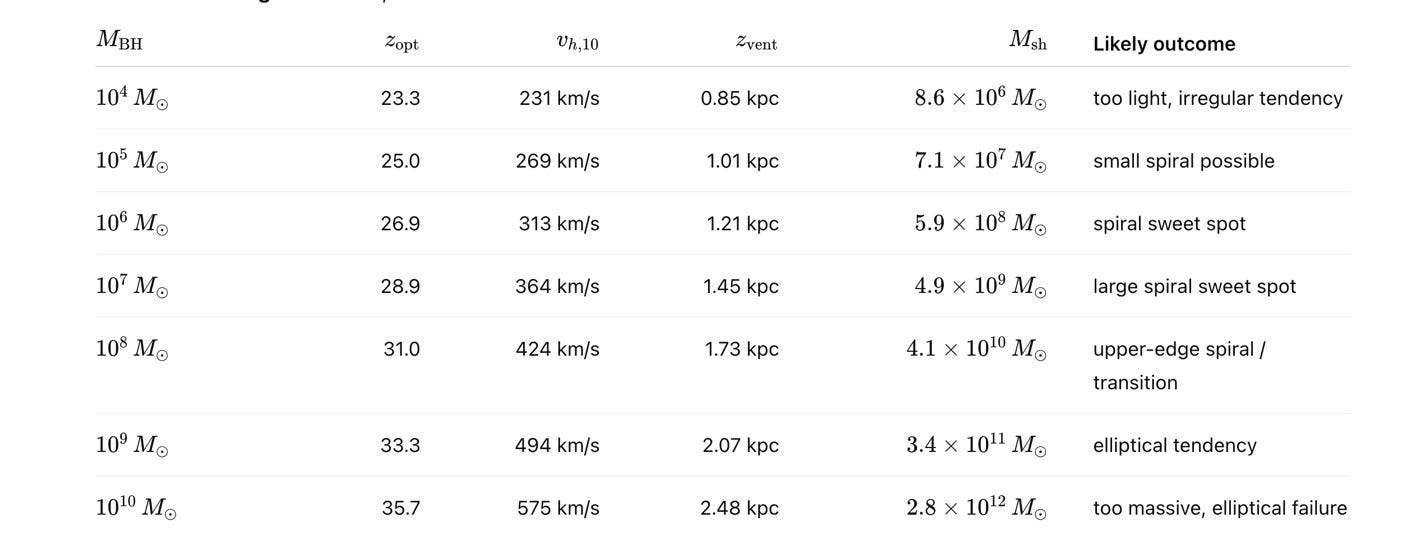
So, even a quick-and-dirty analysis (with some pretty conservative, mainstream assumptions and no new physics), can plausibly reproduce the narrative model for cocoon formation and collapse across the relevant mass and redshift range.
Obviously this is just a crude toy, and there is a lot more modelling left to do – the “purely conical jet” assumption is a gross simplification, the plasma density gradient right beside the black hole is more complicated in real life, I’m not crazy about that cocoon aspect ratio, breakout time needs to be generated properly and not set by hand, etc, etc – but it’s off to a pretty good start.
The thing I love about this model, the thing that makes me think this is more likely to be true than the current hodgepodge of disconnected, ad-hoc explanations, is that it’s so COHERENT! A step-by-step, causal, chain-of-events process, with energy flows directed down channels that (within a broad and suggestively tolerant parameter range) lead to highly-structured, predictable outcomes. (And, outside those parameters, very much don’t. It’s EXTREMELY encouraging that both failure modes emerge naturally from the scaling laws, not from tuning the model…) The output of each stage is shaped (I would argue, by evolution) to act as the input of the next. Click, click, click… If you stand back and study the entire process (or set of linked processes), it looks more like embryogenesis (an evolved, and thus fine-tuned, dynamic process of self-assembly) than random matter with arbitrary characteristics blindly bumping and clumping.
PREDICTIONS

This model also, obviously, makes a ridiculous number of strong early-universe predictions, which will require observational confirmation. Ultimately – if the model is correct – we should eventually be able to simply see this entire compressed-spring developmental process play out, from soup to nuts. From an initial wave of direct-collapse supermassive black hole formation (between redshifts 35 to 25), to the mature spiral galaxies, with (orderly) thin and (disorderly) thick discs, that we see in the contemporary universe. But seeing the whole process, all the way back, will require new and improved instruments. Meanwhile, here are some things we might be able to see relatively soon with the instruments we have already, starting with a particularly juicy prediction…
PREDICTION 1.) Closer observation will reveal a (dimmer, kiloparsec-scale) protogalactic structure around the (bright, parsec-scale, point-source) Little Red Dots.
The full proto-galaxy at that point should comprise a not-very-bright thick disc of older stars, wrapped around a more massive and even dimmer plasma-dominated (and still magnetically supported) thin disc – which may only be beginning to relax and form stars – with, at its centre, a supermassive black hole wrapped in a thick plasma blanket (the hot, bright, collapsed cocoon core).
Some additional, more detailed predictions, for bonus points:
1a.) The lower the overall mass of the proto-galaxy, the puffier and more oblate those thin discs will still be. (And the less blue/UV light you’ll see; large-scale star formation across the thin disc can’t start till collapse to a disc is almost complete, but those lower masses collapse more slowly.)
1b.) The higher the mass, the less puffy/oblate and more disclike the thin disc, and the more recent star formation (UV/blue light) you should see around the edges of the point-source “red dot” image. That’s because full gravitational collapse and subsequent relaxation of larger-mass thin disc fields to allow star formation happens earlier. (In either case, both 1a and 1b, closer observation should reveal many older, redder, thick disc stars already existing above and below the thin disc.)
1c.) Overall, basically, across the mass range, you should see both a slightly chaotic stellar structure (thick disc), surrounding a much dimmer, more coherent, rotating plasma disc structure with a strong spiral (compressed helical) field (future thin disc). And a Little Red Dot at the centre, outshining it all.
The James Webb Space Telescope has several Little Red Dot observation programs planned over the next year that could potentially see some of this. And Program 7404 (the delightfully named “How I wonder what you are – do JWST’s Little Red Dots twinkle?”) is already gathering data, and just dropped a preprint. It found Little Red Dots don’t twinkle fast and sharp (over hours/days/weeks), like light from a naked supermassive-black-hole-driven quasar, or normal Active Galactic Nucleus, would. (Quasars and AGNs twinkle because, being so compact, their light output varies rapidly with the amount of gas/plasma falling into their accretion disc and immediately heating up.) Instead, on the months-long scale they measured, it looks like a steady glow (though there may yet be variability over longer scales, we don’t know). That’s consistent with the very thorough reprocessing, blurring, and smoothing out of the accretion disc’s (flickering) light by absorption deep inside the thick plasma blanket that surrounds the supermassive black hole after cocoon collapse. So, consistent with my model. Which is one reason I want this model out there now, in advance of any further observations that it predicts!
Further James Webb Space Telescope observations coming up that could potentially confirm this prediction:
Program: GO 8358, “Revealing the True Nature of Little Red Dots with Deep Continuum Observations of an IR-Bright LRD at z=3.1.” Watch for it in late 2027, probably September–December-ish.
Program: GO 12396, “What Lies at the Hearts of the Little Red Dots? Efficient, Ultra-Deep Observations of the ‘Black Hole Stars’ MoM-BH*-1 and The Cliff.” Watch for it somewhere between mid-2027 and mid-2028. (The exact window hasn’t yet been assigned.)
PREDICTION 2.) Early spiral galaxies should start out with strong, coherent, spiral (or compressed helical) magnetic fields.
Self-explanatory. The field is born big, with the disc. How do you prove it? Basically, point the sixty-six big, sexy, radio telescopes that make up ALMA (the Atacama Large Millimeter/submillimeter Array, in Chile’s high Atacama desert) at a strongly gravitationally-lensed galaxy (for the extra magnification needed to get enough detail to make this observation), at an extremely high redshift – so, a galaxy that’s much too young for the mainstream’s long, slow, bottom-up, “weak dynamo” process to have built a strong spiral field – and see if ALMA can resolve polarised dust signals showing it already has a strong, coherent spiral magnetic field.
PREDICTION 3.) Young thin discs should already be kinematically '‘cold”, even while still magnetically-locked plasma; rotation of thin disc stars, once they start forming, should therefore be orderly from the start. (And bars should therefore form far earlier than the old models predict.) We’re already seeing some evidence for this. New observations should confirm it.
PREDICTION 4.) Thick discs should be older, shorter in radius, poorer in metals; thin discs should be younger, wider in radius, richer in metals – ALL THE WAY BACK. If I’m right, that structure is inherent to spiral galaxies, it doesn’t emerge slowly and hesitantly and late from some chaotic mess. And, obviously, you should see thick disc stars appearing before thin disc stars.
PREDICTION 5.) The most massive early collapsed-cocoon discs (above ten to the ten solar masses) with the largest radii (above three kiloparsecs) should fail to stabilise as discs; thus fail to become spiral galaxies; and instead be seen to spectacularly disintegrate, in waves of explosive star formation, to become burnt-out red-and-dead ellipticals directly, through that single collapse-and-disintegrate process, without needing mergers.
A corollary:
5a.) What LOOK like close-packed proto-galaxies merging in the early universe will often prove instead to be parts of a disintegrating failed massive early disc. Those parts, in the absence of coherent disc-wide magnetic support, are now independently collapsing and undergoing star formation, and thus resemble unstructured protogalaxies. Those starmaking parts will then indeed “merge” to form an elliptical galaxy; but they originated in one immense collapsed plasma structure that proved too large to stabilise into a spiral.
An even more cheeky and speculative corollary to the corollary:
5b.) At the most massive scale, this may explain remarkably early “clusters” of elliptical galaxies; they may be disintegrated sub-parts of an ultra-large failed disc generated by an ultramassive black hole.
An upcoming program which may find evidence for this:
Program: GO 8512, “Dissecting Coalescence of Primeval Galaxies.” (Full data release should be roughly July–September 2027.)
Etc, etc… There are too many predictions to list really; as our instruments improve, and we see further back, there’s an entire smorgasbord of them. It’s just a totally different model to the old hierarchical-mergers one.
Isn’t it a gorgeous new model? And it simply emerges from doing a first-principles think-through of the consequences of strong jets in dense plasma in the very early universe! No new physics, no new particles; everything in it has been observed at some point, it just hasn’t been assembled like this before into a coherent narrative that makes sense. So simple and elegant.
Do you see any fatal flaws? Possible improvements? (The maths can definitely be improved, it’s only an extremely crude first pass, with a couple of things held constant that really need to be variables.) Basically, if you have any thoughts or suggestions, or want to talk about it at any time, I would be delighted!
And thanks again for all your help in getting me support, it’s wonderful having the time to work away obsessively on this.
Fondest regards,
–Julian
Well, that’s a cleaned-up and expanded version of the email I’ve been sending to some of the people supporting my work, laying out the model I’ve spent the last year developing in stealth mode. As you can see, there is plenty of work still to do. But this is as far as I think I can take it on my own. (Domain experts, get in touch!) To non-expert readers: I’m impressed (and happy) you made it to the end. Wasn’t that a wild ride? I’ll be posting a more general-reader-friendly version here at some point in the next few months. Hit Subscribe now, if you would like to be sent that automatically once I post it.
Meanwhile, whether expert or not, your thoughts are welcome. Please comment below. And, again, feel free to pass this on to anyone who you think might help improve the model. More minds needed!
If you are interested in the parent theory that ultimately led to this model, you can read about Lee Smolin’s original theory of cosmological natural selection here, and about my more recent three-stage model of cosmological natural selection here. These are currently orphaned theories; a handful of scholars are working on them in their spare time, but there are no journals supporting them, no departments exploring them, no fields taking responsibility for them. As evolutionary theories of cosmology, they fall between the current field boundaries. I am therefore helping develop a new field of evolutionary cosmology to develop them further. Here is a good guide to that new field. Again, please get in touch through this slightly out of date contact form, or just email me directly, if you want to help.
Putting numbers on it; the mean baryon/gas/plasma density in our universe today is 4.2 by 10 to the minus 31 grams per cubic centimeter (basically, hard vacuum). But at redshift 30, it’s 1.25 by 10 to the minus 26 grams per cubic centimeter. And close to a million-solar-mass direct collapse black hole (about 10 parsecs out) straight after its collapse, the density is probably roughly one or two (or three) by 10 to the minus 19 grams per cubic centimeter. So yeah, as dense as contemporary star-forming molecular clouds.
We don’t have direct observational data from that far back, but it’s generally confidently assumed that the smooth medium in that high-redshift, pre-star-formation era is neutral gas. However, the x-ray and UV light from the blazing-hot accretion disc would immediately send an expanding spherical ionization front outward through it – i.e., an ongoing blast of highly energetic light, in all directions, that ionizes everything it passes through – so it will be charged plasma close by, not neutral gas. The hot plasma jet will therefore be ploughing through a blanket of cooler plasma, not gas, even though what originally collapsed was indeed neutral gas.
Both the jet head speed and the speed of expansion of the backflow, both being at least a couple of hundred kilometers per second – often more – are well above the threshold required to ionise any neutral hydrogen gas they slam into, so again the compressed shell ends up being all plasma. Further out, it’s neutral gas.
A CAUTIOUS ASIDE ON THAT SCALING RELATIONSHIP: I should make clear that this scaling relationship is not in the existing literature, because nobody’s built a model exactly like this before; but it seems to me a perfectly reasonable assumption. (You can’t NOT have a scaling relationship of roughly this type, for all the reasons given above). And the exact figure I’ve used (at any given fixed radius and redshift, the plasma density should be proportional to black hole mass to the 7/9th power) isn’t pulled out of my ear: it’s simply a scaling consequence of taking the existing radial profile from Aaron Smith’s well-regarded 2017 paper, and assuming self-similar profiles for bigger (and smaller) supermassive direct collapses. Different size; same shape. And yes there are caveats; maybe the profiles won’t be self-similar at larger scales; the specific figure needs to be tested in simulation; the real figure could be a bit higher, could be a bit lower; it probably won’t maintain this clean sub-linear power-law relationship at the extremes; blah blah blah. But you need a figure here to build a model, and this figure lands inside the normal range of the kind of figures that are implied by the literature – they’re all somewhere between a very conservative 0.6 and a more reasonable 0.8, and 7/9 is 0.77777…, which is bang on target – so let’s go! END OF CAUTIOUS ASIDE AND BACK TO GIDDY EXCITEMENT
The fringe plasma percentage is larger for smaller cocoons – reaching up to 30% or more – for obvious topological/geometric reasons: smaller cocoons have a larger surface proportionate to their volume (because volume rises as the cube of the radius, while surface area only rises as the square of the radius); and so proportionately more plasma finds itself at the critical distance from the (also weaker and smaller) field. This maps on to observation: small spiral galaxies have proportionately larger thick discs.
OK, the information buried in this footnote is actually extremely important, but it is also unfortunately SO bloody interesting that I find it actually distracts from the clarity and flow of the main argument – it tends to trigger a whole bunch of either excited or puzzled questions from the reader, depending on their level of knowledge of the field – so I’ve dropped it into a footnote, and will return to it in its own section later. But here you go, for now: in my model, the inner-inner 1% of the plasma closest to the centre fell directly back onto the supermassive black hole when the cocoon collapsed. So that inner 1% is additionally heated, and thus disrupted, by the hot donut of the accretion disc. Yeah, the resulting supermassive-black-hole-wrapped-in-a-hot-thick-plasma-blanket is going to look awfully like the Little Red Dots the James Webb Space Telescope keeps seeing in the very early universe! (Cue excited/puzzled questions). But we will get to that…
Dropping this to a long footnote, to keep the main argument moving, but… Look at how sweetly this works. And how fine-tuned it looks! (My argument is, of course, that it has been fine-tuned by evolution, because this helps universes reproduce more efficiently by producing more black holes – more offspring – per unit mass.) A cloud of pure neutral hydrogen gas (and some helium) has difficulty cooling and collapsing to form stars, because collapsing gas gets denser, thus raising the pressure, thus raising the temperature. Warm gas expands! And so the collapse stops. So to keep collapsing, it has to shed that increased heat from the collapse somehow. But it’s in space! There is no solid ground to conduct away heat, and no surrounding air to convect away heat. Radiation is the only way left it can lose heat. That means some atoms in the cloud need to be excited enough by the raised pressure and temperature to shed energy as photons of light, radiating away the heat out of the cloud and allowing the collapse to continue. (Warm things glow, which cools them.) But neutral hydrogen gas forms molecular hydrogen, H2; two hydrogen atoms bonded in a symmetrical dumbbell shape. And symmetrical molecules like H2 find it hard to shed energy as light. (Technically – and yeah, I’m still oversimplifying here – they don’t have a permanent electric dipole i.e. a positive and negative end; as a result, when other excited atoms or molecules bang into them, spinning them, that spin doesn’t generate an electromagnetic field that can rise high enough to trigger a photon release.) But because the neutral hydrogen gas has been enriched by elements from the thick disc’s supernovae, it’s already full of carbon and oxygen. And carbon and oxygen act as wildly efficient refrigerants, both separately and together. Carbon monoxide, for example, has a great permanent electric dipole, nicely balanced to soak up energy even from quite cold gas and release it as light. (The carbon end is slightly negative and the oxygen end is slightly positive). Ionised carbon (C+), neutral carbon (C), carbon monoxide (CO), water (H2O)… they all shed energy as light, extremely efficiently, at different frequencies, each working best in different parts of the cloud. (CO deep in the cloud, C+ on the surface, etc.) And so small amounts of carbon and oxygen can do a HUGE amount of rapid cooling. (Which makes sense in evolutionary terms: the colder you can get the gas, the smaller the individual region that can collapse, the more stars you can make per cloud. And thus, ultimately, the more stellar-collapse black holes –offspring; reproductive success – per cloud.) This snowplough-neutral-gas-that’s–enriched-with-refrigerants process ALSO allows for massively parallel star formation; one problem with stars is that, once fusion starts, they blast the surrounding neutral gas with radiation and ionise it, turning off star formation in their neighbourhood. But if a WHOLE BUNCH of stars can all form across a rapidly-formed dense cloudfront together, almost simultaneously along the spiral arm, they can all get their collapse and fusion underway before they have a chance to disrupt each other; by the time their fusion process kicks off and they start ionising the local neighbourhood, their neighbouring stars have already also collapsed, and are on their way to fusion. So my model predicts EXTREMELY BURSTY star formation, from about redshift 15 onward. It will look like a chaotic bunch of weirdly fast star formation coming out of nowhere; it will actually be waves of newly-neutral gas getting snowploughed into dense clouds, and rapidly cooling to semi-simultaneously form stars all along a spiral arm.
That’s because mass alone isn’t the only factor here, though it’s the dominant one, so a few extremely-high-mass spirals will make it past that mass cutoff – the “Big Wheel” is a spiral at redshift 3.25 with a mass of about 3.7 × 10 to the 11 solar masses – but most won’t. Plus, most spirals we now see that are larger than the cutoff grew to that size later.
Obviously, mergers also happen, and mess up galaxies of all sizes; that’s a separate issue, occurring later. I’m just talking about small irregulars, born that way. In my model, there are obviously still loads of mergers, but they are secondary, later, and often disruptive; not, as in ΛCDM, ubiquitous, early, and the primary way galaxies form. And, obviously, my model therefore predicts faaaaar less mergers overall, in the early universe, than does ΛCDM. It also implies that some of what we are currently interpreting as early-universe “mergers” are in fact either failed massive discs disintegrating, or asymmetric bursts of star formation occurring in relaxing discs. For example, a burst of star formation in a relaxing thin disc, happening against the background of the same proto-galaxy’s thick disc, resembles the merger of a small, low mass, bright new galaxy with a separate small, low mass, dim old galaxy. Rather than what they are (in my model): two parts of a single spiral galaxy, that is slowly developing and becoming visible like a Polaroid photograph.
A note on the math… This compressed spring model was sparked by my initial thought, a year ago, “Hey, if a stalled jet blew a bubble, it would automatically contain a 3D helical field… interesting… oh hang on a minute, when that bubble inevitably cooled, the 3D helical field in the bubble would collapse to form a 2D spiral field in a disc, WOW!” I then developed the model by thinking through the implications from first principles (while applying some ideas borrowed from evolutionary biology, and embryogenesis). So, it was a narrative theory until very late in the process, though I did check the math rather crudely as I went, to make sure I wasn’t wasting my time developing a physically impossible theory. By the time I decided I was ready to develop a toy model, OpenAI had already released GPT-5, which came out August 2025, and which, in Pro mode, was finally pretty reliable at math – though you did, and still do, have to double-check everything, because it could, and still can, make some extremely silly assumptions if you don’t prompt rigorously, and check answers for bullshit even more rigorously. Because I am a lousy mathematician, I therefore used ChatGPT 5.4 Pro’s assistance (and later 5.5) for a lot of the maths modelling, which is of course fantastically dangerous, with all the obvious potential problems inherent to LLM use; but the toy model mostly uses easy-to-follow algebra using uncontroversial formulae taken from the mainstream literature, so I think I caught most of its (and hopefully my) screwups. I also used Claude and Gemini as Reviewers One and Two, to provide a couple of external – and less emotionally involved! – viewpoints; mostly to independently critique and fact-check the maths and physics in each draft. And I got a couple of human scientists to read the late drafts.
Worst simplification/assumption: I’m still working on when exactly breakout happens across the range, because there are so many factors involved in setting that boundary; so, to set the cocoon size, I’ve artificially fixed breakout at two million years for now, as all the relative speeds/distances/densities seem about right around then. Still, that’s a major fudge that needs work.
There’s an argument that the pressure from the cocoon should collimate the jet, keeping it tight, but there’s also an argument that in this particular and extreme regime that won’t happen, for complicated but conservative and plausible reasons I lay out in the long version – adding in realistic electromagnetics! – so I’ll stick with a conical jet.
Another caveat, for pedants: OK, yes, if that looks too neat, it’s because it is a little too neat. There are a bunch of other factors that will influence the cooling time (it changes somewhat with plasma density, etc), but none make a HUGE (order of magnitude) difference, and this is an email, not a book.
Yes, this is really crude, but it kind of works, is close to the extreme compression of values the scaling predicts, and my attempts to be more precise got messy without really changing the figure by much, so I’ll leave fixing it till later.
Hi, I have a bunch of questions: 1) how do you make globular clusters? They seem to be the oldest (stellar) objects around. Even a galaxy like ours has over 100 of these objects. Notoriously, they are dark-matter free, meaning we can simulate them well enough without assuming they have their own dark matter halo, while dwarf galaxies tend to be dark-matter dominated instead (all of this within the Lambda-CDM model, which I am not a fan of). 2) what about the scaling laws, most importantly the baryonic Tully-Fisher relation, but also the central black hole mass - bulge mass relation (Magorrian relation), will you picture justify those? The TF relation is particularly tricky for dark matter cosmologies to justify 3) where are the primordial SMBHs now? if they form huge jets at first but are quiescent now (presumably gas-starved), what happened, did they sweep away the gas themselves? At the very least is should be possible to reveal them via gravitational lensing 4) what does your theory predict in terms of astrochemistry, in terms of primordial gas enrichment?
Welcome back, I missed you